
Tracing back to China

It's been a decade since I have been in China, but retracing steps and revisiting topics adds heft to connectedness. I am long past due for a revisit. My most recent visit was in July of 2016, the occasion of the sixth World Congress of the International Society of Business, Economics and Ethics held in Shanghai, where my wife Lynn was a presenter. One of the highlights of that visit was a three-day tour across Zhejiang Province, including a village populated primarily by descendants of Confucius.


A year earlier, a China Central Television (CCTV) film crew working on a Chinese documentary, Maritime Silk Road, wanted to film a story of an American working in China whose family also had long ties with China and decided that my story qualified.
When I first went to Asia in 1976-7, practicing as a landscape architect in the Taiwan Tourism Bureau, I had no idea that I had an ancestor involved in the China trade. For years, all I knew about my ancestor John Bryant (1780-1865) was that he formed a firm called Bryant & Sturgis. Full stop. I had no idea what business he was in, let alone that the firm dominated the China trade for decades. I soon discovered that the famous sea voyage memoir, Two Years Before the Mast, took place on Bryant & Sturgis ships.
After I spent 2007 at AGER, a Shanghai-based landscape architectural firm, I returned to Boston to open an office for the firm. I also decided to see what the archives at Baker Library at Harvard Business School and the Peabody Essex Museum (PEM) had on Bryant & Sturgis. While the former had an account book in Bryant’s hand, the latter had his logbook in Bryant’s steady hand duly recording blow by blow a pirate attack in the Pearl River below Canton (Guangzhou). I decided to write a monograph on Bryant's entrepreneurial exploits.

In early 2014, Colin Lin, a Guangzhou-based entrepreneur, approached me requesting help in organizing a Boston cultural and trade delegation to Guangzhou. He wanted to commemorate, on August 28, 2014, the 230th anniversary of the first direct contact between Americans and Chinese, when the Boston-built ship Empress of China, carrying the future first envoy to China, a Bostonian named Samuel Shaw, dropped anchor on the Pearl River. I was all in.
In extending invitations to cultural institutions to join in the delegation, I approached Peabody Essex Museum, the Forbes House Museum and the Chinese Historical Society of New England. Back in 1977 while working at the Taiwan Tourism Bureau I had organized a historical tour of Taiwan for Crosby Forbes’ Museum of the American China Trade, now Forbes House Museum, so filling his shoes this time out was his son, historian and Forbes Museum Trustee Rob Forbes. I also engineered a State Resolution proclaiming August 28, 2014 as Guangzhou Guangdong Boston Massachusetts Day through State Rep. Jonathan Hecht, a fellow Overseer at Massachusetts Historical Society who had spent time in China.
Though I had worked all over China during my seven years with AGER, (living in Shanghai in 2007, then running its Boston office until early 2016), I had never been to Guangzhou. It did not disappoint. As John Bryant might have said, "What took you so long!"

On the big day in Guangzhou, I presented a first edition of the memoir of Samuel Shaw to Gu Jianqing, chief sponsor of the delegation, chairman of the Guangzhou Association of Social Science Studies and a China trade history buff. Mr Gu loved the Empress of China story and was thrilled to get the book. I also presented him with a copy of my monograph on John Bryant.

But there was more. I had learned that the founder of my profession of landscape architecture, Frederick Law Olmsted, long before he found his calling, but already with the eye of a journalist, had shipped to Guangzhou as a common sailor in 1843. He had somehow gotten himself into the city where foreigners were not allowed. He had been welcomed, despite his lack of status, into the homes, shops, temples and shipyards of ordinary Chinese people. This lesson in kindness toward strangers, which he called “civility,” came to mind later when he formed his vision for parks for the people, beginning with Central Park in New York. In its way, Guangzhou had helped inspire that vision. I thrilled the Mayor of Guangzhou when as a member of the delegation I told him this story at his banquet.
It was my turn to be thrilled after wondering aloud how moving it would be if a descendant of Howqua (Wu Bingjian), the fabled hong merchant and mentor to the Forbes brothers, could join us. Sure enough, Wu Lingli, Howqua’s descendant, a civil engineer, joined us in a Starbucks near People’s Park in Guangzhou and showed Rob Forbes and me family photos over the generations on his laptop.
Guangzhou Daily loved the Bryant and Olmsted story, and so did Gu Jun and Huang Rui of CCTV, who were scouting for the forthcoming Maritime Silk Road production. I told Rui about my China Trader ancestor who had been in Guangzhou in 1809, and my artistic great aunt Helen Paine Kimball who had taken hundreds of photos of ordinary Chinese people with her hand-held camera in 1913. I gave Rui a copy of my monograph on John Bryant..
Fortuitously, three months after my visit to Guangzhou, my book on urban public open space best practices, Cities with Heart came out, in a bilingual edition by the China Architecture and Building Press. I went on a book tour in Beijing, Chengdu, Shanghai and Guangzhou speaking on a number of campuses. And CCTV was there.

The CCTV crew filmed me in conversation with Colin Lin in several locations in Guangzhou.


CCTV sent the film crew to Massachusetts for further filming. The program aired in 2015.

Fast forward to July 2026, eleven years after my book tour across China, and a decade since my last visit. AGER founder Ma Xiaowei, who had hired me in Shanghai in 2006, was now my neighbor in the States and regularly traveled to China to oversee projects. When he came over to our house and saw the treasure trove of photographs by Helen Paine Kimball, he agreed that many of them should go on display in China, and would help make it happen. Serendipitously, CCTV's Hong Kong based Huang Rui was then in Boston to film another documentary and reached out. I invited her and her film crew over and showed them the photographs as well. My great aunt Helen Paine Kimball never had the chance to share them with China. It was time for them to come home, and thanks to my friends' connections, they just might.
HELEN PAINE KIMBALL
Artist and photographer Helen Paine Kimball (1881-1947) was the fifth of seven children of General Charles Jackson Paine, a director of two transcontinental railroads, and Julia Bryant Paine, granddaughter of John Bryant. Educated at the Boston Museum School, she became a talented artist who painted in oils, etched, created photographic silhouettes, and photographed people and landscapes. She married Rev. Thatcher Raymond Kimball in 1905.
In 1912-13 a year-long around-the-world trip of a lifetime took the couple to Egypt, Palestine, Ceylon, India, Burma, China, Japan, Java, and the Philippines, before they headed back to Boston by way of Hawaii. Helen photographed scenes of everyday life in China at the dawn of its post-dynastic era. She took hundreds of photographs of ordinary Chinese people and even got up close to China's first President Sun Yatsen. Her collection of candid photos is probably unmatched by any other Western photographer in those years, let alone one who was a woman.

Scenery and monuments did not interest Helen nearly as much as people—ordinary people going about their daily lives. Her hand-held Kodak No. 0 GRAPHIC camera, introduced in 1909, featured an adjustable viewfinder that could be rotated to take photos at right angles. That allowed the photographer to face in one direction while taking a candid photo of an unsuspecting subject in a different direction.

Many photos show that Helen had no need to use that feature to elicit warm feelings from her subjects. What is most remarkable is how intimate many of the images are. People did not turn away. Something about her manner and earnest looks won them over to this stranger from afar with the rare camera who stepped in close to them. Her artistic training endowed each frame with composition, even drama.

Back in Boston, Helen faced the enormous task of developing, printing, and organizing five thousand negatives of what she called Oriental Life. She created a folio album of 75 contact sheets of her 1500 best images, each sheet stamped “Oriental Life © H P Kimball 1914” (or 1915) in a small lozenge of her design. Of those 1500 photos, 218 are of China. Four quarto albums contain 300 additional images taken in China.


Helen knew she needed to share her photographs. Foster Brothers, 4 Park Square, Boston published Pictures from Oriental Life with over one hundred of her copyrighted photographs. The photographs, all copyrighted by "H. P. Kimball," were captioned for an audience including school-age children.


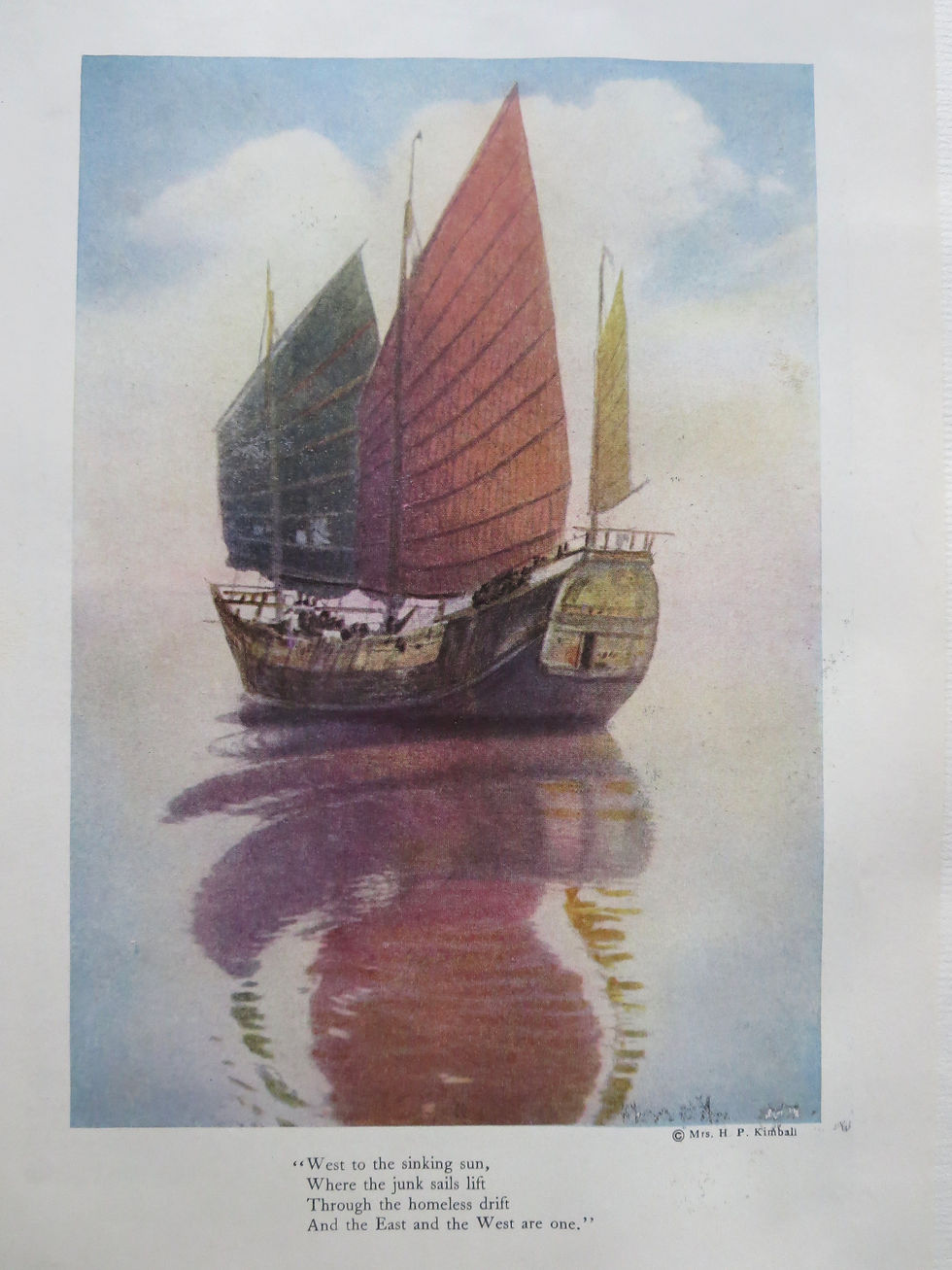
Helen also colorized photos printed on glass for magic lantern presentations, an early form of projection entertainment.


And, talented portraitist that she was, she often did charcoals of her subjects.


Or created etchings like this one she gave her favorite nephew, my Dad.

Sadly, Helen and Thatcher were unable to have children, he died 20 years before her, and she became disabled with MS, robbing her of decades of productivity. Her legacy is in her art.
I hope to report before long that at last Helen Paine Kimball's many vivid photographs of Chinese people at the dawn of the modern era have finally come home, to be seen not just virtually, but face to face.


Comments